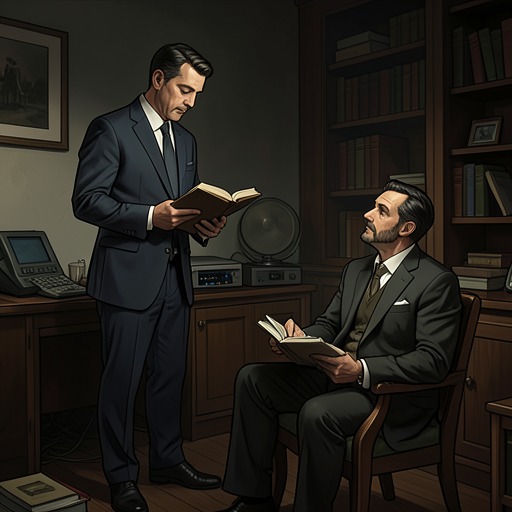
Lionel’s investigation of the Yorkville Zendo
Motherless BrooklynLionel Essrog’s investigation of the Yorkville Zendo turns a search for Tony Vermonte into a discovery about Gerard Minna—and into a trap. Lionel approaches the temple as a hunter, hoping to catch its occupants unprepared; instead, he finds Gerard in the role of Roshi and sees him coordinate with Giant Killer, the same enforcer Lionel associates with Frank Minna’s murder. The inquiry’s decisive revelation is inseparable from its immediate consequence: Lionel is seized and struck with a gun.
The pre-dawn approach
The investigation begins before seven in the morning, with Lionel leaving Danny Fantl asleep at the office counter, Gilbert Coney still in his cell, and Tony missing. He starts the L&L Pontiac and chooses the Zendo over the other unresolved demands on his attention. Going early is tactical: he hopes to arrive before the monks or the mobsters he suspects may be inside, and to gain the advantage of surprise.
By the time Lionel reaches the Upper East Side, the neighborhood is waking. Shopkeepers are bringing out fruit stands, vendors are unpacking paperbacks, and people are hurrying to work. The doorman at the entrance next to the Zendo is a new, apparently inexperienced young man named Walter, rather than the one who harassed Lionel the day before. Lionel tries his luck with him, but Walter is due to finish his shift soon and offers little prospect of an easy route inside.
Lionel paces the block, drawing close to the Zendo and then retreating as he gathers his nerve. The place feels to him like a shrine, and he imagines its connection to Frank as a kind of martyrdom. His urge to rewrite the temple’s plaque reflects a wish to replace its public account with the story he is trying to uncover. When he finally rings the bell, he does so five times. The number feels complete, though his familiar count of six remains in his mind; he wonders whether his counting has changed in commemoration of Frank and whether the unexplained extra figure in his mental tally might be Bailey or Irving. The investigation is already shaped by the unstable overlap between deliberate deduction and involuntary association.
Entry and cautious questioning
After a long wait, a young woman with short black hair and glasses opens the door. She is barefoot, dressed casually, and holding a broom. Lionel asks whether he can ask about the Zendo and what happens there. She offers to let him inside because it is cold, and he accepts. The welcome is sincere enough to make him feel safe, but he also treats it as an opportunity: he intends to gather information from within the temple while remaining alert to the danger he associates with it.
Inside, Lionel tries to keep the conversation going without disrupting it with his tics. He asks whether anything strange has been happening, including whether Roshi might be in trouble. The woman appears puzzled and does not confirm his suspicion. Lionel then asks whether the Zendo has had visitors, particularly anyone who came by the previous night. He has Tony in mind, because Tony had ostensibly called on the Zendo after a meeting at L&L. She says she knows of no such visitor. Lionel considers describing Tony, but decides that Tony could have visited without her seeing him, and shifts to asking whether anyone else is in the building. His questions expose the limits of what this first conversation can establish: he has entered the place, but has not yet connected its occupants to the disappearance he is pursuing.
The sitting and the recognition of Gerard
At a later visit, Kimmery greets Lionel at the door and says he has arrived in time to join the sitting. Her welcome and kiss on the cheek bring him an immediate sense of euphoria, and he follows her instruction to take a cushion, sit away from the front, and concentrate on his breathing. The scene offers him a route further into the Zendo, but the quiet also sharpens his awareness of the people gathered there.
When his eyes adjust to the dim room, Lionel notices a bronze gong at the front and empty cushions near it, apparently reserved for important visitors. Wallace sits near the front. A row ahead of Lionel are two men he recognizes as the doormen who had tried to abduct him. They have exchanged their blue suits for black robes and adopted the posture of practiced seekers of serenity. The change of clothing does not reassure him; it makes the Zendo’s calm appearance part of the problem he is investigating.
A procession of six bald Japanese monks enters, and one strikes Lionel on the back of the head as he passes. Soon a seventh, American teacher arrives: a large, bald man whose abundant black back and shoulder hair rises around his neck, unlike the other monks’ appearance. Lionel connects this figure with Kimmery’s description of the teacher and identifies him as Roshi. The recognition is initially entangled with the recurring name Irving and with a joke Lionel cannot immediately make sense of. Then the pieces align: Roshi is Gerard Minna, and Gerard is the voice Lionel heard on the wire. Lionel cannot tell whether the man’s profile or the nagging joke brings him to the answer first. The delay matters: the clues have been present, but his associative thinking has not yet arranged them into a clear conclusion.
Exposure and seizure
Lionel’s recognition does not remain private. A monk reprimands him for disturbing the Zendo, and Lionel answers with disruptive wordplay. A monk approaches with a keisaku paddle; Giant Killer rises, puts a bag of kumquats into his jacket pocket, and prepares to intervene. Gerard looks at Lionel without showing whether he recognizes the teenager he left behind at the St. Vincent’s Home for Boys schoolyard fence nineteen years earlier. Kimmery puts a hand on Lionel’s knee, and he returns the gesture. Even in the commotion, his involuntary patterns of response remain active.
The monks strike Lionel with the paddle. He grabs it and pulls it from the monk’s hands, while Giant Killer advances through the seated crowd. At that moment, Lionel sees Gerard give the giant a slight nod, and the giant nod back. Lionel reads this silent exchange as the return of the team responsible for Frank Minna’s murder and understands that he may be next. Gerard’s signal is the investigation’s most consequential piece of evidence: the apparent religious teacher and the physically imposing enforcer are acting together.
Giant Killer wraps Lionel in his arms and lifts him. He carries Lionel downstairs and out to the street, then sets him down while returning to his kumquats. The contrast between the assault and the giant’s unhurried eating leaves Lionel shaken and winded, while Giant Killer appears scarcely taxed. He orders Lionel into a vehicle. Lionel obeys despite not wanting to, and as he steps down into the darkness, Giant Killer swings a gun at his head. The blow ends this phase of the investigation in blankness rather than explanation. Lionel has learned who Roshi is and witnessed Gerard’s coordination with Giant Killer, but the immediate price of that knowledge is his capture and unconsciousness.